Phil Wilson Phil Wilson
0 Course Enrolled • 0 Course CompletedBiography
Workday-Pro-Integrations Valid Braindumps Pdf - High-quality Workday Workday-Pro-Integrations Study Center: Workday Pro Integrations Certification Exam
2026 Latest Itcerttest Workday-Pro-Integrations PDF Dumps and Workday-Pro-Integrations Exam Engine Free Share: https://drive.google.com/open?id=1_BBQIfhTyoIyCmoRsS4N3pcZhPccWJJA
You may find that on our website, we have free renewal policy for customers who have bought our Workday-Pro-Integrations practice quiz. You can enjoy one year free updated service. This policy greatly increase the pass percentage of the candidates if they can't pass in one time or in the limited date. And they can enjoy 50% off if they buy them again one year later. All in all, our service is completely considerate. Come to experience our Workday-Pro-Integrations Training Materials.
The team of experts hired by Workday-Pro-Integrations exam torrent constantly updates and supplements the contents of our study materials according to the latest syllabus and the latest industry research results, and compiles the latest simulation exam question based on the research results of examination trends. We also have dedicated staffs to maintain updating Workday-Pro-Integrations practice test every day, and you can be sure that compared to other test materials on the market, Workday-Pro-Integrations quiz guide is the most advanced. It is known to us that having a good job has been increasingly important for everyone in the rapidly developing world; it is known to us that getting a Workday Pro Integrations Certification Exam certification is becoming more and more difficult for us. That is the reason that I want to introduce you our Workday-Pro-Integrations prep torrent. I promise you will have no regrets about reading our introduction. I believe that after you try our products, you will love it soon, and you will never regret it when you buy it.
>> Workday-Pro-Integrations Valid Braindumps Pdf <<
Workday-Pro-Integrations Study Center | Workday-Pro-Integrations PDF Question
Three versions for Workday-Pro-Integrations exam cram are available. Workday-Pro-Integrations PDF version is printable and you can learn them anytime. Workday-Pro-Integrations Online test engine is convenient and easy to learn, and supports all web browsers and if you want to practice offline, you can also realize by this. In addition, Workday-Pro-Integrations Online soft test engine have testing history and performance review, you can have a general review of what you have learned before start practicing. We offer you free update for one year for Workday-Pro-Integrations training materials, and the update version will be sent to your email automatically.
Workday Workday-Pro-Integrations Exam Syllabus Topics:
| Topic | Details |
|---|---|
| Topic 1 |
|
| Topic 2 |
|
| Topic 3 |
|
| Topic 4 |
|
Workday Pro Integrations Certification Exam Sample Questions (Q21-Q26):
NEW QUESTION # 21
Refer to the following scenario to answer the question below.
You have been asked to build an integration using the Core Connector: Worker template and should leverage the Data Initialization Service (DIS). The integration will be used to export a full file (no change detection) for employees only and will include personal data.
What configuration is required to output the value of a calculated field which you created for inclusion in this integration?
- A. Configure Integration Field Attributes.
- B. Configure Integration Maps.
- C. Configure Integration Field Overrides.
- D. Configure Integration Attributes.
Answer: C
Explanation:
The scenario involves a Core Connector: Worker integration using the Data Initialization Service (DIS) to export a full file of employee personal data, with a requirement to include a calculated field in the output.
Core Connectors rely on predefined field mappings, but custom calculated fields need specific configuration to be included. Let's analyze the solution:
* Requirement:Output the value of a calculated field created for this integration. In Workday, calculated fields are custom-built (e.g., using Report Writer or Calculated Fields) and not part of the standard Core Connector template, so they must be explicitly added to the output.
* Integration Field Overrides:In Core Connectors, Integration Field Overrides allow you to replace a delivered field's value or add a new field to the output by mapping it to a calculated field. This is the standard method to include custom calculated fields in the integration file. You create the calculated field separately, then use overrides to specify where its value appears in the output structure (e.g., as a new column or replacing an existing field).
* Option Analysis:
* A. Configure Integration Field Attributes: Incorrect. Integration Field Attributes refine how delivered fields are output (e.g., filtering multi-instance data like phone type), but they don't support adding or mapping calculated fields.
* B. Configure Integration Field Overrides: Correct. This configuration maps the calculated field to the output, ensuring its value is included in the exported file.
* C. Configure Integration Attributes: Incorrect. Integration Attributes define integration-level settings (e.g., file name, delivery protocol), not field-specific outputs like calculated fields.
* D. Configure Integration Maps: Incorrect. Integration Maps transform existing field values (e.g.,
"Married" to "M"), but they don't add new fields or directly output calculated fields.
* Implementation:
* Create the calculated field in Workday (e.g., via Create Calculated Field task).
* Edit the Core Connector: Worker integration.
* Navigate to the Integration Field Overrides section.
* Add a new override, selecting the calculated field and specifying its output position (e.g., a new field ID or overriding an existing one).
* Test the integration to confirm the calculated field value appears in the output file.
References from Workday Pro Integrations Study Guide:
* Core Connectors & Document Transformation: Section on "Configuring Integration Field Overrides" explains how to include calculated fields in Core Connector outputs.
* Integration System Fundamentals: Notes the use of overrides for custom data in predefined integration templates.
NEW QUESTION # 22
Your manager has asked for a value on their dashboard for how many days away the birthdays are of their direct reports. The format of the output should be [Worker's Name]'s birthday is in [X] days, where you must calculate the number of days until a Worker's next birthday. An example output is "Logan McNeil's birthday is in 103 days." Which calculated field functions do you need to accomplish this?
- A. Increment or Decrement Date, Format Number, Text Constant, Concatenate Text
- B. Build Date, Format Date, Extract Single Instance, Format Text
- C. Format Date, Increment or Decrement Date, Extract Single Instance, Format Text
- D. Date Difference, Format Number, Text Constant, Concatenate Text
Answer: D
Explanation:
Implementation:
D). Increment or Decrement Date, Format Number, Text Constant, Concatenate Text: Incorrect. Increment or Decrement Date can't directly calculate days to a future birthday without additional complexity; Date Difference is more appropriate.
Use Date Difference to calculate days from today to the next birthday (adjusting the year dynamically with additional logic if needed).
Apply Format Number to ensure the result is a clean integer.
Use Text Constant for static text ("'s birthday is in " and " days").
Use Concatenate Text to combine Worker Name, static text, and the formatted number.
Reference from Workday Pro Integrations Study Guide:
Workday Calculated Fields: Section on "Date Functions" explains Date Difference for calculating time spans.
Report Writer Fundamentals: Covers Concatenate Text and Text Constant for string building in reports.
Explanation:
The requirement is to create a calculated field for a dashboard that displays a worker's name and the number of days until their next birthday in the format "[Worker's Name]'s birthday is in [X] days" (e.g., "Logan McNeil's birthday is in 103 days"). This involves calculating the difference between today's date and the worker's next birthday, then formatting the output as a text string. Let's break down the necessary functions:
Date Difference:To calculate the number of days until the worker's next birthday, you need to determine the difference between the current date and the worker's birthdate in the current or next year (whichever is upcoming). The Date Difference function calculates the number of days between two dates. In this case:
Use the worker's "Date of Birth" field (from the Worker business object).
Adjust the year of the birthdate to the current year or next year (if the birthday has already passed this year) using additional logic.
Calculate the difference from today's date to this adjusted birthday date. For example, if today is February 21, 2025, and Logan's birthday is June 4 (adjusted to June 4, 2025), Date Difference returns 103 days.
Format Number:The result of Date Difference is a numeric value (e.g., 103). To ensure it displays cleanly in the output string (without decimals or unnecessary formatting), Format Number can be used to convert it to a simple integer string (e.g., "103").
Text Constant:To build the output string, static text like "'s birthday is in " and " days" is needed. The Text Constant function provides fixed text values to include in the final concatenated result.
Concatenate Text:The final step is to combine the worker's name (e.g., "Logan McNeil"), the static text, and the calculated days into one string. Concatenate Text merges multiple text values into a single output, such as "Logan McNeil" + "'s birthday is in " + "103" + " days".
Option Analysis:
A . Format Date, Increment or Decrement Date, Extract Single Instance, Format Text: Incorrect. Format Date converts dates to strings but doesn't calculate differences. Increment or Decrement Date adjusts dates but isn't suited for finding days until a future event. Extract Single Instance is for multi-instance fields, not relevant here. Format Text adjusts text appearance, not numeric calculations.
B . Build Date, Format Date, Extract Single Instance, Format Text: Incorrect. Build Date creates a date from components, useful for setting the next birthday, but lacks the difference calculation. Format Date and Extract Single Instance don't apply to the core need.
C . Date Difference, Format Number, Text Constant, Concatenate Text: Correct. These functions cover calculating the days, formatting the number, adding static text, and building the final string.
NEW QUESTION # 23
Refer to the following XML to answer the question below.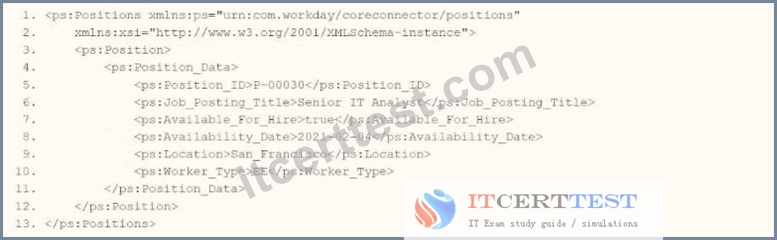
You need the integration file to format the ps:PositionJD field to 10 characters and report any truncated values as an error.
How will you start your template match on ps:Position to use Document Transformation (DT) to do the transformation using ETV with your truncation validation?
- A.

- B.
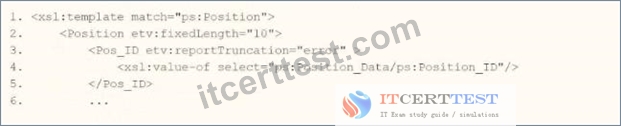
- C.
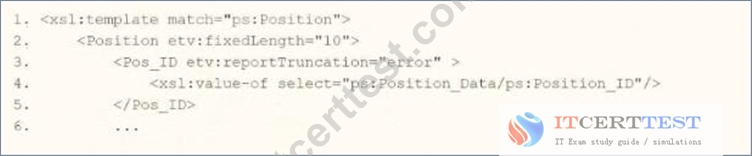
- D.
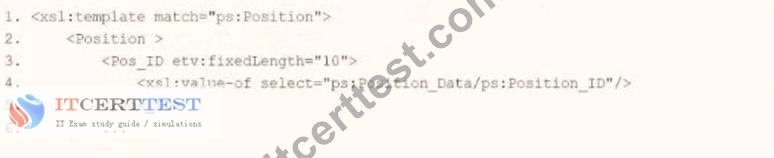
Answer: A
Explanation:
In Workday integrations, Document Transformation (DT) using XSLT is employed to transform XML data, such as the output from a Core Connector or EIB, into a specific format for third-party systems. In this scenario, you need to transform the ps:Position_ID field within the ps:Position element to a fixed length of 10 characters and report any truncation as an error using Workday's Extension for Transformation and Validation (ETV) attributes. The template must match the ps:Position element and apply the specified formatting and validation rules.
Here's why option D is correct:
Template Matching: The <xsl:template match="ps:Position"> correctly targets the ps:Position element in the XML, as shown in the provided snippet, ensuring the transformation applies to the appropriate node.
ETV Attributes:
etv:fixedLength="10" specifies that the Pos_ID field should be formatted to a fixed length of 10 characters. This ensures the output is truncated or padded (if needed) to meet the length requirement.
etv:reportTruncation="error" instructs the transformation to raise an error if the ps:Position_ID value exceeds 10 characters and cannot be truncated without data loss, aligning with the requirement to report truncated values as errors.
XPath Selection: The <xsl:value-of select="ps:Position_Data/ps:Position_ID"/> correctly extracts the ps:Position_ID value from the ps:Position_Data child element, as shown in the XML structure (<ps:Position_ID>P-00030</ps:Position_ID>).
Output Structure: The <Position><Pos_ID>...</Pos_ID></Position> structure ensures the transformed data is wrapped in meaningful tags for the target system, maintaining consistency with Workday integration practices.
Why not the other options?
A .
xml
WrapCopy
<xsl:template match="ps:Position">
<Position>
<Pos_ID etv:fixedLength="10">
<xsl:value-of select="ps:Position_Data/ps:Position_ID"/>
</Pos_ID>
</Position>
</xsl:template>
This option includes etv:fixedLength="10" but omits etv:reportTruncation="error". Without the truncation reporting, it does not meet the requirement to report truncated values as errors, making it incorrect.
B .
xml
WrapCopy
<xsl:template match="ps:Position">
<Position etv:fixedLength="10">
<Pos_ID etv:reportTruncation="error">
<xsl:value-of select="ps:Position_Data/ps:Position_ID"/>
</Pos_ID>
</Position>
</xsl:template>
This applies etv:fixedLength="10" to the Position element instead of Pos_ID, and etv:reportTruncation="error" to Pos_ID. However, ETV attributes like fixedLength and reportTruncation should be applied to the specific field being formatted (Pos_ID), not the parent element (Position). This misplacement makes it incorrect.
C .
xml
WrapCopy
<xsl:template match="ps:Position">
<Position etv:fixedLength="10">
<Pos_ID etv:reportTruncation="error">
<xsl:value-of select="ps:Position_Data/ps:Position_ID"/>
</Pos_ID>
</Position>
</xsl:template>
Similar to option B, this applies etv:fixedLength="10" to Position and etv:reportTruncation="error" to Pos_ID, which is incorrect for the same reason: ETV attributes must be applied to the specific field (Pos_ID) requiring formatting and validation, not the parent element.
To implement this in XSLT for a Workday integration:
Use the template from option D to match ps:Position, apply etv:fixedLength="10" and etv:reportTruncation="error" to the Pos_ID element, and extract the ps:Position_ID value using the correct XPath. This ensures the ps:Position_ID (e.g., "P-00030") is formatted to 10 characters and reports any truncation as an error, meeting the integration file requirements.
:
Workday Pro Integrations Study Guide: Section on "Document Transformation (DT) and ETV" - Details the use of ETV attributes like fixedLength and reportTruncation for formatting and validating data in XSLT transformations.
Workday Core Connector and EIB Guide: Chapter on "XML Transformations" - Explains how to use XSLT templates to transform position data, including ETV attributes for length and truncation validation.
Workday Integration System Fundamentals: Section on "ETV in Integrations" - Covers the application of ETV attributes to specific fields in XML for integration outputs, ensuring compliance with formatting and error-reporting requirements.
NEW QUESTION # 24
What task is needed to build a sequence generator for an EIB integration?
- A. Edit Tenant Setup - Integrations
- B. Put Sequence Generator Rule Configuration
- C. Create ID Definition/Sequence Generator
- D. Configure Integration Sequence Generator Service
Answer: C
Explanation:
In Workday, a sequence generator is used to create unique, sequential identifiers for integration processes, such as Enterprise Interface Builders (EIBs). These identifiers are often needed to ensure data uniqueness or to meet external system requirements for tracking records. The question asks specifically about building a sequence generator for an EIB integration, so we need to identify the correct task based on Workday's integration configuration framework.
Understanding Sequence Generators in Workday
A sequence generator in Workday generates sequential numbers or IDs based on predefined rules, such as starting number, increment, and format. These are commonly used in integrations to create unique identifiers for outbound or inbound data, ensuring consistency and compliance with external system requirements. For EIB integrations, sequence generators are typically configured as part of the integration setup to handle data sequencing or identifier generation.
Analyzing the Options
Let's evaluate each option to determine which task is used to build a sequence generator for an EIB integration:
* A. Put Sequence Generator Rule Configuration
* Description: This option suggests configuring rules for a sequence generator, but "Put Sequence Generator Rule Configuration" is not a standard Workday task name or functionality. Workday uses specific nomenclature like "Create ID Definition/Sequence Generator" for sequence generator setup. This option seems vague or incorrect, as it doesn't align with Workday's documented tasks for sequence generators.
* Why Not Correct?: It's not a recognized Workday task, and sequence generator configuration is typically handled through a specific setup process, not a "put" or rule-based configuration in this context.
* B. Create ID Definition/Sequence Generator
* Description: This is a standard Workday task used to create and configure sequence generators.
In Workday, you navigate to the "Create ID Definition/Sequence Generator" task under the Integrations or Setup domain to define a sequence generator. This task allows you to specify the starting number, increment, format (e.g., numeric, alphanumeric), and scope (e.g., tenant-wide or integration-specific). For EIB integrations, this task is used to generate unique IDs or sequences for data records.
* Why Correct?: This task directly aligns with Workday's documentation for setting up sequence generators, as outlined in integration guides. It's the standard method for building a sequence generator for use in EIBs or other integrations.
* C. Edit Tenant Setup - Integrations
* Description: This task involves modifying broader tenant-level integration settings, such as enabling services, configuring security, or adjusting integration parameters. While sequence generators might be used within integrations, this task is too high-level and does not specifically address creating or configuring a sequence generator.
* Why Not Correct?: It's not granular enough for sequence generator setup; it focuses on tenant- wide integration configurations rather than the specific creation of a sequence generator.
* D. Configure Integration Sequence Generator Service
* Description: This option suggests configuring a service specifically for sequence generation within an integration. However, Workday does not use a task named "Configure Integration Sequence Generator Service." Sequence generators are typically set up as ID definitions, not as standalone services. This option appears to be a misnomer or non-standard terminology.
* Why Not Correct?: It's not a recognized Workday task, and sequence generators are configured via "Create ID Definition/Sequence Generator," not as a service configuration.
Conclusion
Based on Workday's integration framework and documentation, the correct task for building a sequence generator for an EIB integration isB. Create ID Definition/Sequence Generator. This task allows you to define and configure the sequence generator with the necessary parameters (e.g., starting value, increment, format) for use in EIBs. This is a standard practice for ensuring unique identifiers in integrations, as described in Workday's Pro Integrations training materials.
Surprising Insight
It's interesting to note that Workday's sequence generators are highly flexible, allowing customization for various use cases, such as generating employee IDs, transaction numbers, or integration-specific sequences.
The simplicity of the "Create ID Definition/Sequence Generator" task makes it accessible even for non- technical users, which aligns with Workday's no-code integration philosophy.
Key Citations
* Workday Pro Integrations Study Guide, Module 3: EIB Configuration
* Workday Integration Cloud Connect: Sequence Generators
* Workday EIB and Sequence Generator Overview
* Configuring Workday Integrations: ID Definitions
NEW QUESTION # 25
Refer to the following scenario to answer the question below.
You need to configure a Core Connector: Candidate Outbound integration for your vendor. The connector requires the data initialization service (DIS).
The vendor needs the file to only include candidates that undergo a candidate assessment event in Workday.
How do you accomplish this?
- A. Set the integration transaction log to subscribe to specific transaction types.
- B. Create an integration map to output values for candidates with assessments.
- C. Configure the integration services to only include candidates with assessments.
- D. Make the Candidate Assessment field required in integration field attributes.
Answer: C
Explanation:
The scenario requires configuring a Core Connector: Candidate Outbound integration with the Data Initialization Service (DIS) to include only candidates who have undergone a candidate assessment event in Workday. Core Connectors are event-driven integrations that rely on business process transactions or specific data changes to trigger data extraction. Let's analyze how to meet this requirement:
Understanding Core Connector and DIS:The Core Connector: Candidate Outbound integration extracts candidate data based on predefined services and events. The Data Initialization Service (DIS) ensures the initial dataset is populated, but ongoing updates depend on configured integration services that define which candidates to include based on specific events or conditions.
Candidate Assessment Event:In Workday, a "candidate assessment event" typically refers to a step in the recruiting business process where a candidate completes an assessment. The requirement to filter for candidates with this event suggests limiting the dataset to those who triggered an assessment-related transaction.
Integration Services:In Core Connectors, integration services determine the scope of data extracted by subscribing to specific business events or conditions. For this scenario, you can configure the integration services to monitor the "Candidate Assessment" event (or a related business process step) and include only candidates who have completed it. This is done by selecting or customizing the appropriate service within the Core Connector configuration to filter the candidate population.
Option Analysis:
A . Configure the integration services to only include candidates with assessments: Correct. This involves adjusting the integration services in the Core Connector to filter candidates based on the assessment event, ensuring only relevant candidates are included in the output file.
B . Set the integration transaction log to subscribe to specific transaction types: Incorrect. The integration transaction log tracks processed transactions for auditing but doesn't control which candidates are included in the output. Subscription to events is handled via integration services, not the log.
C . Make the Candidate Assessment field required in integration field attributes: Incorrect. Integration field attributes define field-level properties (e.g., formatting or mapping), not the population of candidates included. Making a field "required" doesn't filter the dataset.
D . Create an integration map to output values for candidates with assessments: Incorrect. Integration maps transform or map field values (e.g., converting "United States" to "USA") but don't filter the population of candidates included in the extract. Filtering is a service-level configuration.
Implementation:
Edit the Core Connector: Candidate Outbound integration.
In the Integration Services section, select or configure a service tied to the "Candidate Assessment" event (e.g., a business process completion event).
Ensure the service filters the candidate population to those with an assessment event recorded.
Test the integration to verify only candidates with assessments are extracted.
Reference from Workday Pro Integrations Study Guide:
Core Connectors & Document Transformation: Section on "Configuring Integration Services" explains how services define the data scope based on events or conditions.
Integration System Fundamentals
NEW QUESTION # 26
......
Real Workday Workday-Pro-Integrations Exam Questions certification makes you more dedicated and professional as it will provide you complete information required to work within a professional working environment. We have received testimonials from thousands of people who have accomplished Workday Pro Integrations Certification Exam (Workday-Pro-Integrations) only because of the legitimate and trustworthy Workday-Pro-Integrations exam dumps. It's not simple to achieve Workday Pro Integrations Certification Exam (Workday-Pro-Integrations) exam certification.
Workday-Pro-Integrations Study Center: https://www.itcerttest.com/Workday-Pro-Integrations_braindumps.html
- Workday-Pro-Integrations Latest Test Bootcamp ⛑ Practice Workday-Pro-Integrations Test Online 🛀 Test Workday-Pro-Integrations Passing Score 🤹 Search for 【 Workday-Pro-Integrations 】 and download it for free immediately on ➠ www.testkingpass.com 🠰 🍷Workday-Pro-Integrations Latest Test Bootcamp
- Workday-Pro-Integrations – 100% Free Valid Braindumps Pdf | High-quality Workday Pro Integrations Certification Exam Study Center 🐌 Search on { www.pdfvce.com } for ➽ Workday-Pro-Integrations 🢪 to obtain exam materials for free download ⏏Workday-Pro-Integrations Training Pdf
- 2026 Workday-Pro-Integrations Valid Braindumps Pdf - High Pass-Rate Workday Workday Pro Integrations Certification Exam - Workday-Pro-Integrations Study Center 🧈 Search for ▶ Workday-Pro-Integrations ◀ and easily obtain a free download on 「 www.dumpsmaterials.com 」 🛃Workday-Pro-Integrations Exam Certification
- 2026 Workday-Pro-Integrations Valid Braindumps Pdf | High Pass-Rate Workday Pro Integrations Certification Exam 100% Free Study Center 📢 Download ➤ Workday-Pro-Integrations ⮘ for free by simply entering 《 www.pdfvce.com 》 website 🧡Workday-Pro-Integrations Questions
- Pass Guaranteed Quiz Workday - Workday-Pro-Integrations - High-quality Workday Pro Integrations Certification Exam Valid Braindumps Pdf 🌵 The page for free download of ( Workday-Pro-Integrations ) on ▶ www.troytecdumps.com ◀ will open immediately 👟Workday-Pro-Integrations Latest Exam Discount
- Top Workday-Pro-Integrations Valid Braindumps Pdf 100% Pass | Pass-Sure Workday-Pro-Integrations Study Center: Workday Pro Integrations Certification Exam 😍 Easily obtain free download of ▶ Workday-Pro-Integrations ◀ by searching on ✔ www.pdfvce.com ️✔️ 🦱Testing Workday-Pro-Integrations Center
- Workday-Pro-Integrations Questions 📞 Workday-Pro-Integrations Training Pdf 🥛 Practice Workday-Pro-Integrations Test Online 🐲 Open 「 www.validtorrent.com 」 enter ▛ Workday-Pro-Integrations ▟ and obtain a free download 🥛Valid Workday-Pro-Integrations Exam Labs
- Tips to Crack the Workday-Pro-Integrations Exam ⛹ Search for “ Workday-Pro-Integrations ” and download exam materials for free through “ www.pdfvce.com ” 🥰Sample Workday-Pro-Integrations Test Online
- Workday Workday-Pro-Integrations the latest certification exam training materials 🦚 ✔ www.testkingpass.com ️✔️ is best website to obtain ▛ Workday-Pro-Integrations ▟ for free download 🕔Workday-Pro-Integrations Actual Exams
- 2026 Workday-Pro-Integrations Valid Braindumps Pdf - High Pass-Rate Workday Workday Pro Integrations Certification Exam - Workday-Pro-Integrations Study Center 🚡 Immediately open ➤ www.pdfvce.com ⮘ and search for ⮆ Workday-Pro-Integrations ⮄ to obtain a free download 🚀Technical Workday-Pro-Integrations Training
- Workday-Pro-Integrations – 100% Free Valid Braindumps Pdf | High-quality Workday Pro Integrations Certification Exam Study Center 🐲 ➤ www.practicevce.com ⮘ is best website to obtain ( Workday-Pro-Integrations ) for free download 🚼Technical Workday-Pro-Integrations Training
- www.stes.tyc.edu.tw, premiumads.co.zw, www.stes.tyc.edu.tw, www.stes.tyc.edu.tw, myportal.utt.edu.tt, myportal.utt.edu.tt, myportal.utt.edu.tt, myportal.utt.edu.tt, myportal.utt.edu.tt, myportal.utt.edu.tt, myportal.utt.edu.tt, myportal.utt.edu.tt, myportal.utt.edu.tt, myportal.utt.edu.tt, www.stes.tyc.edu.tw, www.notebook.ai, www.stes.tyc.edu.tw, www.stes.tyc.edu.tw, www.stes.tyc.edu.tw, Disposable vapes
DOWNLOAD the newest Itcerttest Workday-Pro-Integrations PDF dumps from Cloud Storage for free: https://drive.google.com/open?id=1_BBQIfhTyoIyCmoRsS4N3pcZhPccWJJA